An honest comparison

Is Wisdsol Edu Advance right for your school?

Most schools arrive here from paper registers, a spreadsheet, or software that does one part of the job. This page sets out plainly what changes, what it costs, and where we are not the right answer.

Comparison 1

Wisdsol vs paper registers and spreadsheets

This is where most schools are starting from — and a spreadsheet is genuinely fine until two people need it at once.

The job Paper / Excel Wisdsol Edu Advance
Fee balances Recalculated by hand each term. A parent asking "what do I owe?" means someone opening a ledger. Balance is current the moment a payment is entered, and the parent can see it themselves.
Receipts A duplicate book. Finding last term's receipt means going through the pile. Printed or thermal receipt, searchable by name, date or receipt number.
Two people at once One file, one person. Copies get emailed and the versions diverge. Everyone works on the same records at the same time.
If the file is lost A corrupted file or a stolen laptop can cost a year's records. Held on the server, not on one person's computer.
Report cards Typed one at a time, with averages and positions worked out by hand. A whole class printed at once, with averages, position and remarks calculated.
Honest answer Costs nothing and needs no training. ~ Costs money and takes a week or two to settle in. Worth it above roughly 60–80 pupils; below that a spreadsheet may genuinely be enough.
Comparison 2

Wisdsol vs basic school management software

Plenty of products record students, fees and results. The difference shows up in the parts a school only discovers it needs once it is already using them.

Capability Typical basic package Wisdsol Edu Advance
Proper accounting Income and expense lists, which an auditor will not accept as books. A real chart of accounts, double-entry journals, trial balance and income statement — and fee payments post into the ledger by themselves.
Works without internet Usually stops when the connection does. Keeps working offline and syncs when the network returns — which matters on a Ghanaian school day.
Parents Often an SMS blast, or nothing. A portal per parent: balances, results, attendance, report books and receipts for their own children only.
Gate and attendance A register marked in class, if at all. QR and PIN clocking at the gate, or a fingerprint / face terminal that records arrivals with nobody typing.
Who can see what A few fixed roles — admin, teacher. Build your own roles and tune any one person's access with checkboxes.
Telling parents A WhatsApp group the school hopes people read, or nothing. Automatic SMS, WhatsApp or email when a payment lands, a balance is due, results are out or a child is absent — with every message logged, its cost tracked and opt-outs honoured.
Lesson notes Exercise books carried to the head's office and back. Written, submitted, returned with remarks or approved — with the full review history kept and approved notes locked.
Online tests Sometimes a quiz, rarely marked automatically. Pupils sit on screen; objective questions marked instantly, essays queued for the teacher, and the score stays provisional until they are done.
Online lessons A link pasted into a group chat each morning. Scheduled lessons with a private room created for you, joined from the pupil's portal, with the register filled in automatically.
Boarding A bed list in a notebook and an exeat book at the gate. Rooms and beds with the allocation rules enforced, an evening roll call, and an alert the moment a boarder is overdue back.
Library A ledger book and a shelf of index cards, or a separate program nobody updates. A full catalogue with lending, returns, renewals, overdue chasing and optional fines — and pupils and parents can see what they have out.
Store & inventory Rarely included — usually a separate book, or a separate program nobody reconciles. A full stock module: items, categories, suppliers, deliveries, stock levels and reorder alerts — and every book, uniform or exercise book issued is tied to the pupil who received it, free or paid.
Comparison 3

Wisdsol vs other Ghana-focused school systems

Several Ghanaian products fit GES well. Here is where we differ — and this is the comparison where the honest answer matters most.

Where we are stronger
  • You are not locked into GES. The same platform runs francophone, Cambridge, Montessori and university structures — useful if you add an international stream later.
  • Accounting that an auditor recognises, not an income-and-expense list.
  • One subscription covers every campus, each with its own data.
  • Built and supported from Accra by the people who write the code — not resold.
Where another product may suit you better
  • If you want a large local sales team on site every week, a bigger vendor will serve you better than we can.
  • If your school runs entirely on WASSCE mock analysis and nothing else, a specialist tool will go deeper than we do.
  • If you need it in a Ghanaian language beyond English and French, we do not have that yet.
  • Under about 60 pupils, honestly, a spreadsheet and a receipt book may still be the cheaper answer.
Why we say this out loud. A school that buys the wrong system loses a term and blames the software — fairly. We would rather you chose us knowing exactly where we are weak than discovered it in the second term.
Built for your kind of school

Where Wisdsol fits particularly well

International schools

Run the Cambridge Pathway or Montessori as first-class structures, not as a Ghanaian template with the labels changed.

  • Early Years through IGCSE and A Level, with the option subjects attached to the right years
  • A*–G grading, CAIE registration and examination-entry fee types
  • Montessori planes of development with mastery records instead of marks
  • Multi-currency, so fees can be charged in what your parents actually pay in
Francophone schools

Togo, Bénin, Côte d'Ivoire, Sénégal and beyond — the whole system in French, not a translated menu over an English structure.

  • Maternelle, CP1–CM2, 6e–3e (BEPC), 2nde–Terminale (BAC)
  • Three trimestres, notes sur 20, coefficients
  • A real bulletin de notes: moyenne générale, rang, appréciation, décision
  • Fees in XOF, and the interface, receipts and report cards all in French
Multi-campus groups

Each campus keeps its own students, staff, fees and accounts — under one subscription and one login for the group owner.

  • Separate data per campus, so one branch cannot see another's records
  • Campuses may run different systems — one GES, one Cambridge — side by side
  • Roles scoped per campus, so a head sees only their own school
  • Universities and colleges too: programme cohorts, credit hours, semesters, GPA or LMD
Often the missing piece

Store & inventory, built in

Most school software stops at fees and marks. But a school also buys exercise books by the carton, hands out uniforms, and owes a supplier at the end of the month — and that is usually tracked in a separate book that never matches the accounts.

Here it is part of the same system, so what left the store and what the parent was charged are the same record.

Register your school
Stock that stays honest
  • Items and categories, with a unit price and a cost price
  • Stock level falls as items are issued, with a reorder alert before you run out
  • Low-stock and out-of-stock flagged on the dashboard
Suppliers and deliveries
  • Record a delivery with its lines and unit costs
  • Part-payments are normal: see what is paid and what is still owed
  • A running balance per supplier
Who actually received it
  • Every issue is tied to a pupil or staff member, dated and signed for
  • Free or paid — a paid issue carries its own balance
  • Answers "has this child been given their books?" in one look
Entitlements & coverage
  • Say what a class or level is entitled to for the year
  • A coverage report shows who has had theirs and who has not
  • No more finding out in week six that a class never got their readers
Also built in

A library that stays accurate

School libraries usually run on a ledger book: a pupil signs for a book, the page is never crossed off, and by the end of the year nobody knows what is missing or who has it.

Here, the number of copies on the shelf is counted from the loans that are actually out — it is never a stored figure that can drift. If the catalogue says two copies are in, two copies are in.

A real catalogue
  • Title, author, ISBN, accession number, edition and language
  • Categories, shelf location and a cover image
  • Reference copies marked so they are never lent out
  • Search by title, author, ISBN or accession number
Lending that cannot go wrong
  • Only books with a copy on the shelf can be issued
  • Borrowing limits per pupil and per staff member
  • The same person cannot take two copies of one title
  • A return can never be recorded twice
Overdue, chased
  • Overdue books listed with how many days late
  • Due-soon list so you can remind before it is late
  • Renewals, counted and capped
  • Optional daily fine, with part-payments tracked
Pupils and parents can see it
  • A pupil sees what they have out and when it is due
  • A parent sees their own children's books
  • Fewer lost books, because everyone can see what they hold
  • Most-borrowed titles, to guide what to buy next
Beyond administration

The teaching side, not just the office

Most school systems stop at fees, marks and attendance — the things the office needs. These are the things a teacher needs.

Lesson notes & vetting
  • Objectives, R.P.K., content, activities, evaluation
  • Submit, return with remarks, approve
  • The full review history kept, never overwritten
  • Approved notes locked; editing starts a new revision
Course materials
  • Notes, slides, worksheets, past papers, videos
  • Staff only, pupils, or pupils and parents
  • Checked when opened, not only when listed
  • Pupils see their own class's materials
Online tests
  • Objective questions marked the moment they submit
  • Essays queued for the teacher to mark
  • Server clock, shuffling, attempt limits
  • Answers never sent to the pupil's browser
Virtual classes
  • A private room created for you — no account needed
  • Or your own Meet, Zoom or Teams link
  • Pupils join from the portal; register fills itself in
  • Each weekly lesson gets its own room
What this is not. We do not run the video ourselves — we schedule it, put the link where pupils can find it and take the register. Nor do we mark essays by machine: an essay scored by string comparison would be confidently wrong, so those go to the teacher. And there is no AI marking, AI career advice or AI prediction here. When we build those, they will be described honestly rather than added to a feature list.
See it working

A term, end to end

The path a school actually walks: bill the fees, take the money, mark the register, enter the marks, print the reports, and let parents see it.
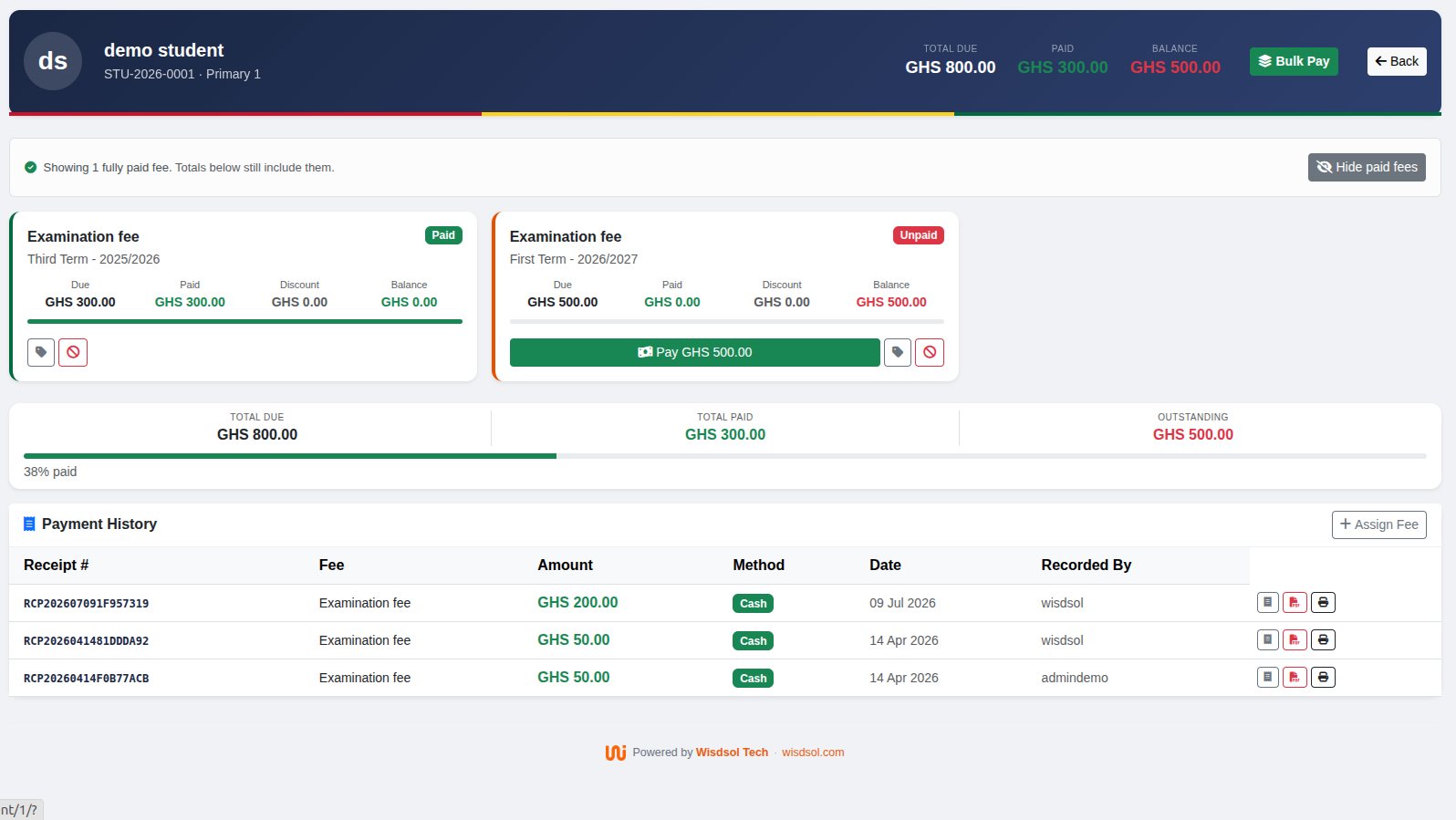
Fees & billing
Fees & billing

Assign a term's fees to a whole class in one pass, then take payments at the desk. Balances update as you go, and part-payments are normal.
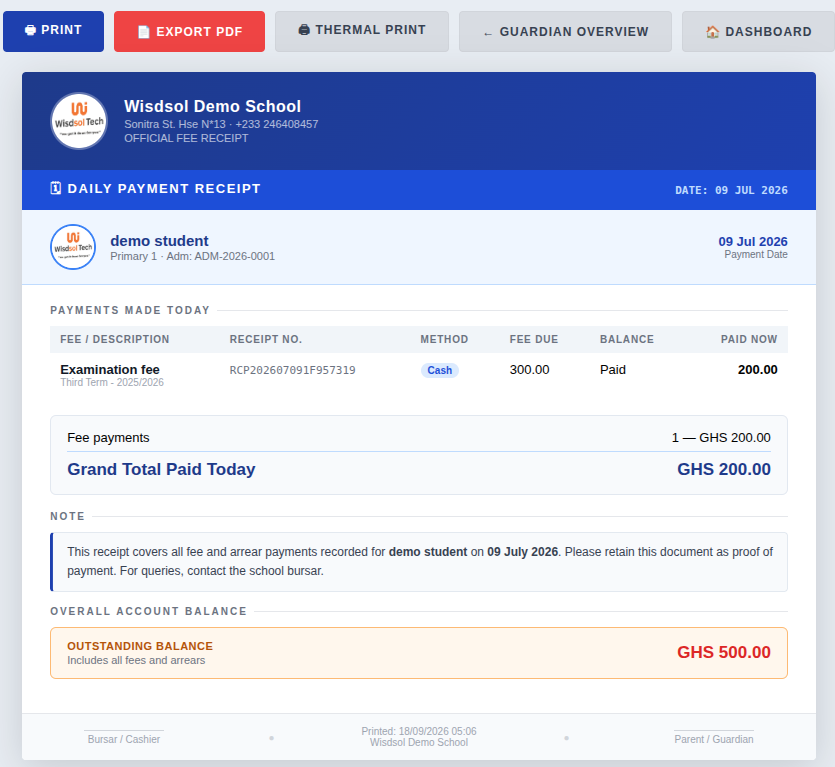
Receipts
Receipts

Print an A4 or thermal receipt as the parent stands there, and the whole day's transactions as one signed sheet at close of business.

Attendance
Attendance

Mark a register in seconds, or let the gate do it — QR, PIN, or a fingerprint terminal that records arrivals with nobody typing.
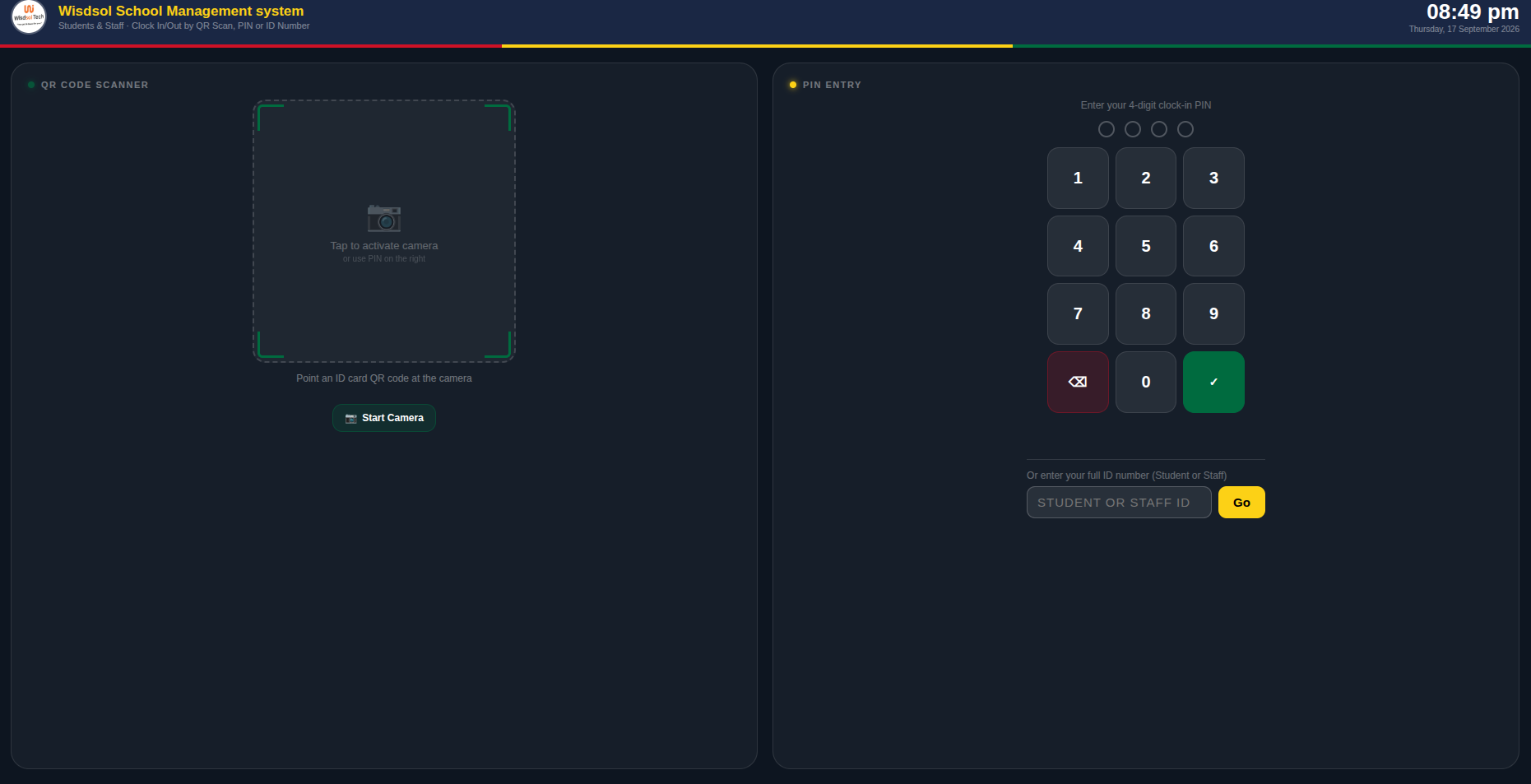
Gate clocking
Gate clocking

A kiosk at the gate that needs no login. Pupils scan in and out, and parents can be told their child arrived.
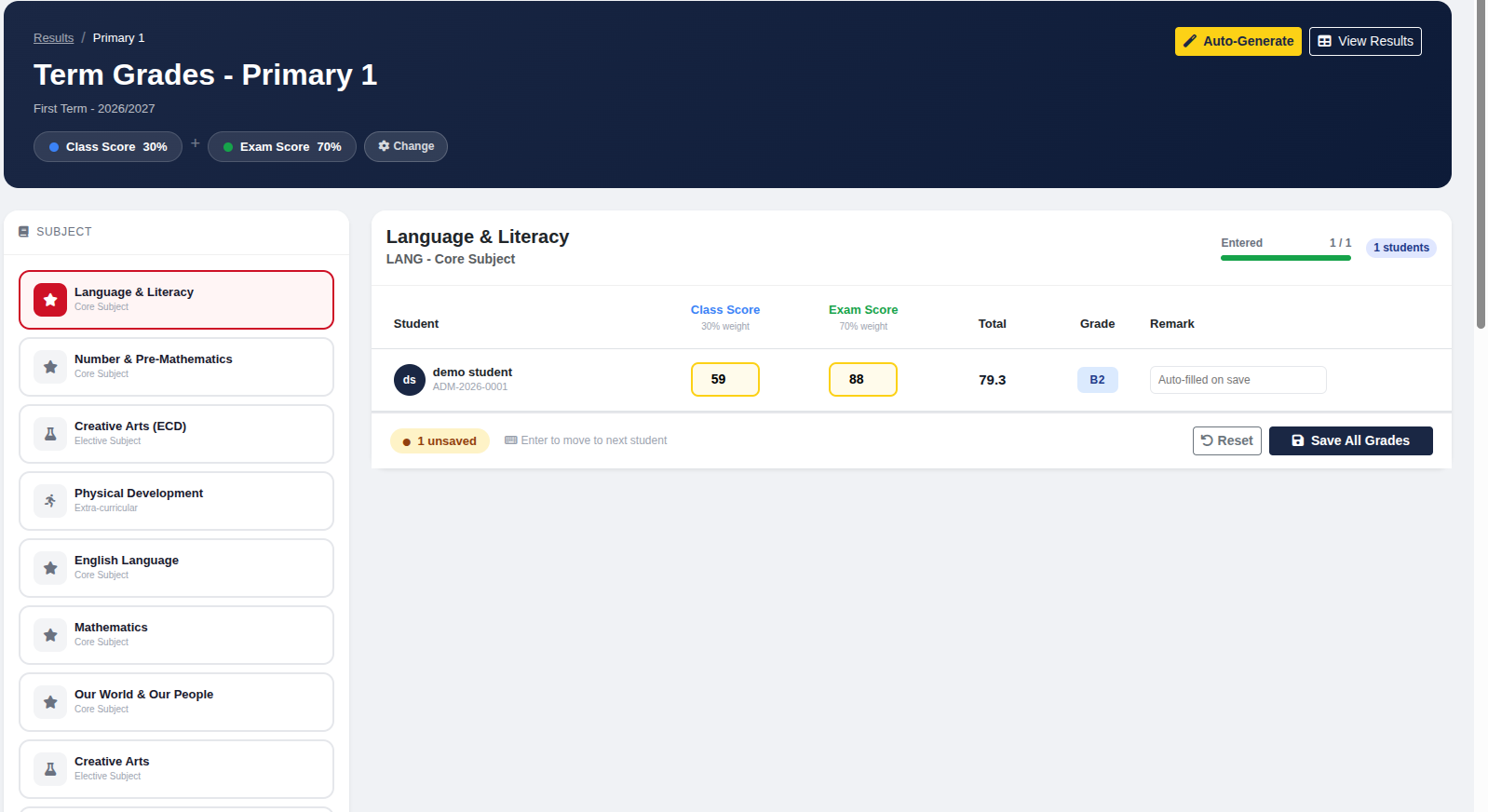
Results entry
Results entry

Enter marks by class and subject with the weighting your system uses — 40/60, sur 20, or Cambridge A*–G.
Report cards
Report cards

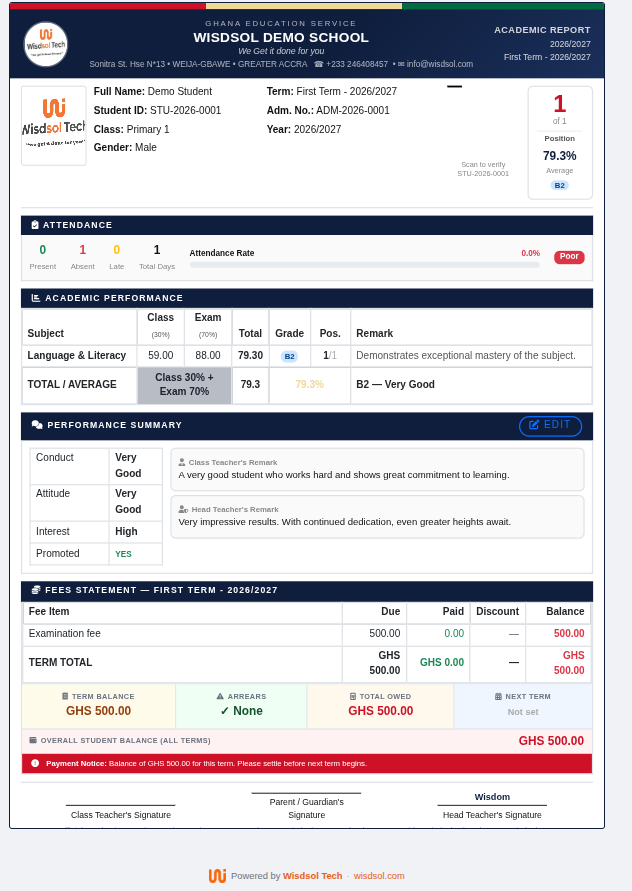
Print a whole class at once, with averages, position and remarks calculated — or a francophone bulletin de notes with coefficients and décision.

Screenshot to be added
static/img/compare/parent.png
Parent portal

Each parent sees their own children only: balances, results, attendance, report books and receipts.
Accounting
Accounting

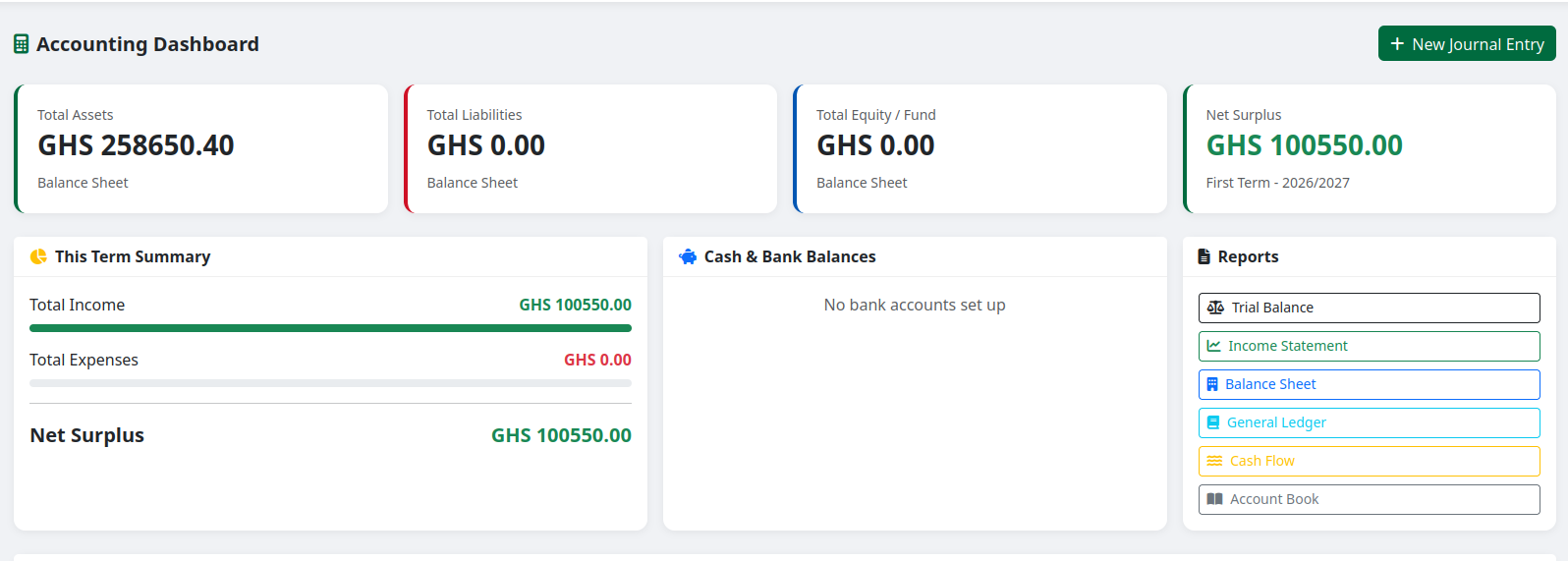
A real chart of accounts, double-entry journals and a trial balance. Fee payments and approved expenses post themselves into the ledger.
Library
Library

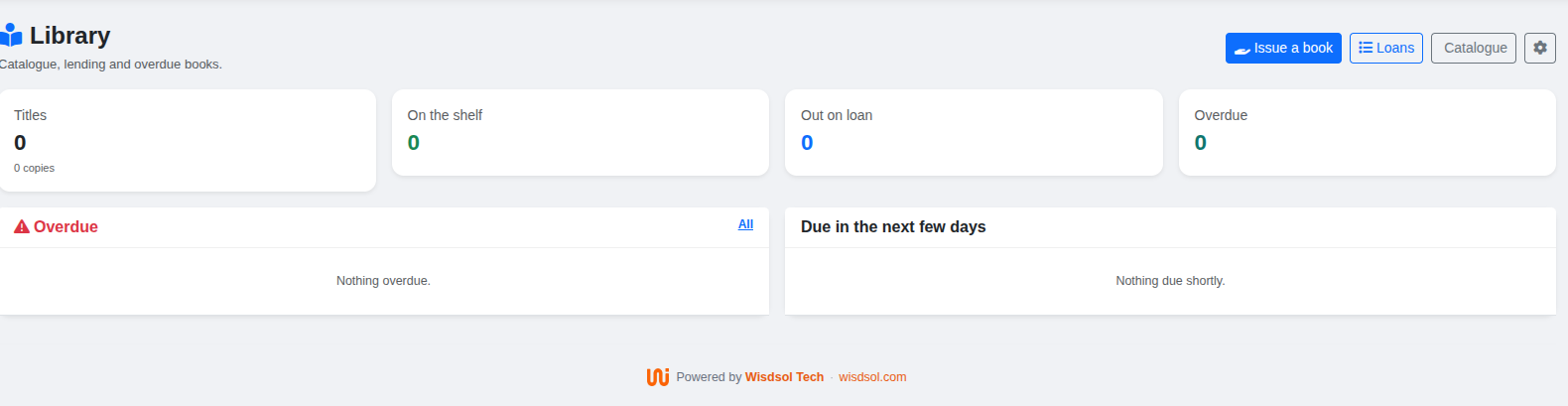
Catalogue, lending and returns, with copies on the shelf counted from the loans actually out — plus overdue chasing, renewals and optional fines.
Store & inventory
Store & inventory

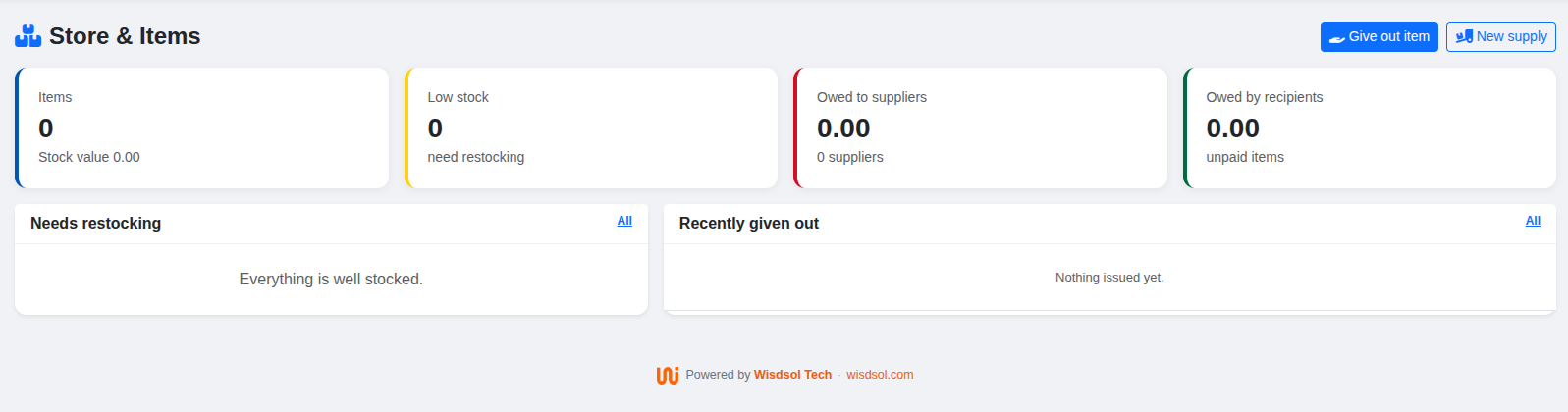
Items, suppliers and stock levels, with every book and uniform issued tied to the pupil who received it.
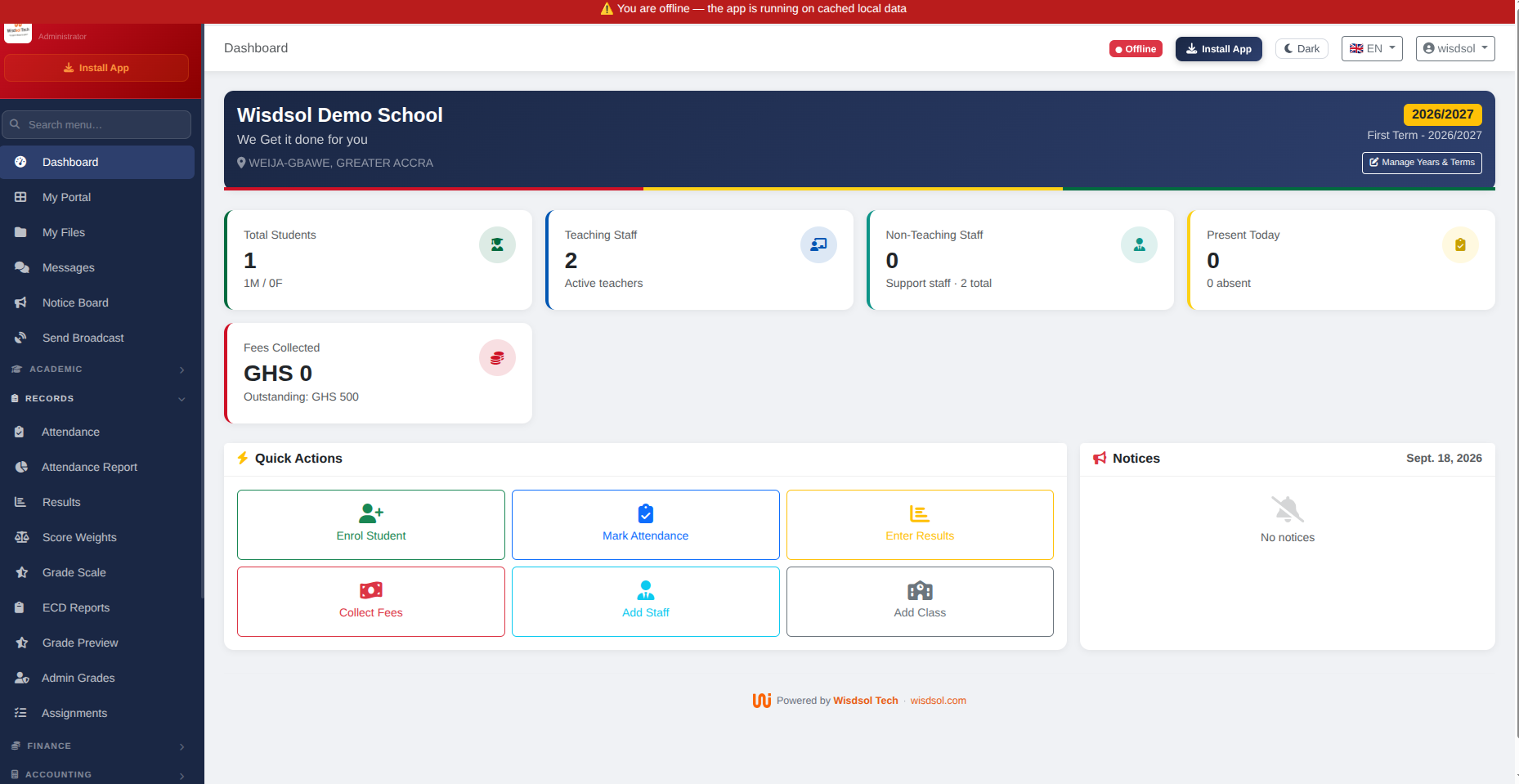
Offline mode
Offline mode

Keeps working when the network drops and syncs when it returns — including a biometric terminal uploading its backlog.

Pricing

What it costs

No setup fee, no charge per parent, and no commission on the fees you collect.

Basic Termly
GHS 1200
per termly
  • Up to 200 students
  • Up to 20 staff
  • 7-day free trial
Choose
Promo
GHS 2500
per termly
  • Up to 1000 students
  • Up to 30 staff
  • 7-day free trial
Choose
Standard Termly
GHS 2100
per termly

For most schools — everything in Starter plus accounting, payroll, assignments, report books, custom roles and data export.

  • Up to 1000 students
  • Up to 100 staff
  • 7-day free trial
Choose
Premium Termly
GHS 4300
per termly

For large schools and school groups — the complete platform, including certificates, the gate & visitor module and priority support.

  • Up to 5000 students
  • Up to 500 staff
  • 7-day free trial
Choose
Campus Termly
GHS 6700
per termly

For universities, polytechnics and colleges — programme cohorts, courses with credit hours, semesters and GPA or LMD grading, with the complete platform included.

  • Up to 10000 students
  • Up to 800 staff
  • 30-day free trial
Choose
What is not included. SMS credits are bought separately, because we pass on what the network charges rather than marking it up. Biometric terminals are hardware you buy once from any supplier — we connect to them, we do not sell them.

Still not sure?

Register and use it with one class for a term. If it does not make your term easier, you will know quickly and cheaply — which is a better test than any comparison table.